
Business and Leadership
From Data to Decisions: Building Confidence as a Leader
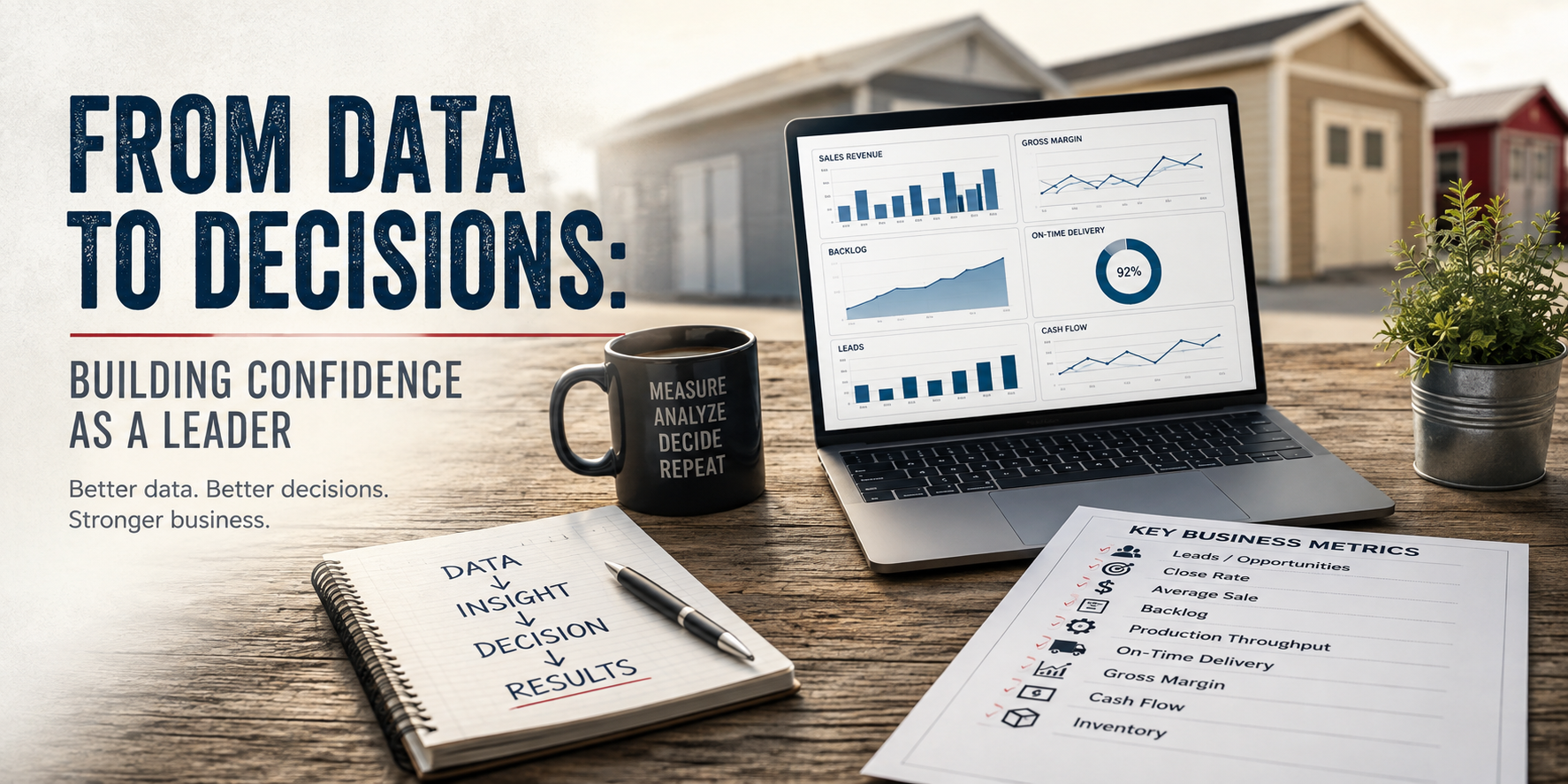
One of the most important things a business leader needs is confidence. Confidence is different than arrogance. It is much more than the loud announcement that says, “I know what I’m doing.” The confidence of competence is a quiet certainty that comes from knowing what is happening in your business and knowing what to do about it.
That kind of confidence is difficult to have when you are leading by gut feelings. Every shed business leader has a sense of how things are going for his company. You know whether the shop feels busy. You know whether sales seem strong. You know when production is falling behind. You probably have a pretty good sense as to whether or not you are making money.
But having a “pretty good sense” is not the same thing as knowing. This is where good data becomes so valuable.
Start with a pulse on the business
The pathway to becoming a data-driven business does not begin with a complicated dashboard containing 47 metrics. It begins with identifying a handful of key measurables that give you a pulse rate on the health of the business. You need clear answers to questions such as the following: How many leads are coming in? How many of those are turning into sales? What is the average sale? How much work is in the backlog? How quickly are your men producing and delivering sheds? What is your gross margin?
The specific numbers will vary from business to business, but the principle is the same: identify the few numbers that tell you whether the business is moving in the direction you want it to go. Then start tracking them.
And this is where something interesting usually happens. You discover that the numbers aren't as reliable as you thought.
The journey toward better data
Maybe your sales numbers are reasonably accurate, but your backlog number isn't. Maybe you know what you sold, but you aren't sure exactly what it cost you to build it. Perhaps inventory is being estimated rather than counted. Maybe some expenses are consistently categorized differently. Perhaps sales are recorded when the order is taken in one place and when the money is collected somewhere else.
Suddenly, the scorecard has exposed something much bigger than a reporting problem. It has exposed weaknesses in the business itself. This journey toward better data often forces a business to tighten up its accounting processes, inventory controls, job costing, order entry, production tracking, and other systems that feed the numbers.
And that's a good thing.
You can't consistently make good decisions with bad data.
But there is another danger. A business can become very good at collecting data without ever becoming good at using it.
Data isn't the goal
I have seen businesses with beautiful scorecards that don't actually change the way anyone runs the business. The numbers are reviewed. Everyone nods. Perhaps someone makes a comment about a number being up or down. Then the meeting moves on. The scorecard becomes a report card rather than a management tool.
But data has very little value simply because it is accurate. The real value of data is what it allows you to decide.
Suppose your sales conversion rate is 28 percent, and your goal is 40 percent. Knowing that number is useful. But knowing the number doesn't change the result. The question is: What are we going to do differently because we know it?
Maybe you discover that your sales team is slow to follow up with internet leads. The decision might be to establish a 15-minute response standard.
Maybe your average ticket has declined. The answer might be to train the sales team to present higher-value options or review how upgrades are being offered.
Maybe production hours per shed are increasing. That could lead to a decision to examine a particular construction process, re-train a crew, or redesign a component.
Maybe your backlog is growing faster than your production capacity. Now you have a decision to make about staffing, overtime, scheduling, outsourcing, or sales.
Nearly every meaningful data point contains an action point, but you have to find it.
Move the number by moving the behavior
This is perhaps the most important step in becoming a data-driven business: you don't manage the number. You manage the behavior that produces the number.
If you want to increase your close rate, what behavior needs to change?
If you want to improve gross margin, what decisions about pricing, purchasing, production or waste must be made?
If you want to reduce days in backlog, what needs to happen differently in production?
If you want to improve cash flow, what has to change in collections, purchasing or scheduling?
The goal isn't simply to say, “Our gross margin needs to be 45 percent.” The goal is to identify the specific decisions and actions that will cause gross margin to move toward 45 percent. That requires leadership. And sometimes it requires hard decisions.
The confidence that comes from knowing
There is a progression here that I believe is worth paying attention to.
First, you measure.
Then you improve the quality of the data.
Then you begin using the data to make decisions.
Finally, you begin to develop confidence in the business because you can see what is happening, and you know how to respond—and that is very different from running a business by intuition.
Your experience and instincts still matter. In fact, experienced leaders often have remarkably good instincts. But data gives those instincts something to work with. Data can confirm what you are sensing—or reveal that your perception isn't telling the whole story.
The objective isn't to turn a shed business into a spreadsheet. The objective is to create a business where the leadership team knows what matters, trusts the numbers, and has the discipline to act on what those numbers are telling them.
Some of the numbers I would watch
Every shed business is different, but if I were helping a shed company develop its first meaningful scorecard, I would start with a relatively short list:
1. Leads / Opportunities
How many qualified opportunities are entering the sales pipeline? If this number declines, future sales will eventually decline.
2. Close Rate
What percentage of opportunities become orders? This tells you a great deal about the effectiveness of your sales process.
3. Average Sale
What is the average revenue per shed sold? This can reveal opportunities in pricing, upgrades, product mix, and sales training.
4. Sales Revenue
How much are you actually selling, compared with your goal? This is the obvious number—but it becomes much more useful when viewed alongside leads, close rate, and average sale.
5. Backlog
How much work has been sold but not yet produced or delivered? Backlog provides an important view of future workload and customer wait times.
6. Production Throughput
How many sheds are being completed per week or month? This gives you a practical measure of production capacity.
7. On-Time Delivery
Are you delivering the customer’s shed when you said you would? This is both a customer-experience measure and an indicator of operational health.
8. Gross Margin
Are you actually making the money you think you are making on each shed? This number becomes especially powerful when your costing and inventory data are reliable.
9. Cash / Accounts Receivable
How much cash is available, and how much money is tied up in receivables? Profitability and cash flow are not the same thing.
10. Inventory
How much cash is sitting in materials and finished goods? Inventory accuracy is also one of those areas where better data often exposes opportunities to improve the underlying business.
You don't necessarily need all ten. In fact, you probably shouldn't start with all ten. Start with the numbers that give you the clearest pulse rate on your business. Establish a baseline, set a goal and identify the person responsible for managing each measurable. Make sure the data is trustworthy. Then begin asking the most important question every time you review the scorecard:
“What are we going to do because of what this number is telling us?”
That is where data becomes leadership. And that is where a scorecard stops being a collection of numbers and starts becoming a tool for building the business you really want.
The ultimate goal isn't better data. The goal is better decisions that will move your business in the right direction—and the confidence that comes from knowing that’s exactly what is happening.
